Easing Function
The easing function data type denotes a mathematical function that describes the rate at which a numerical value changes.
Types of Easing Functions
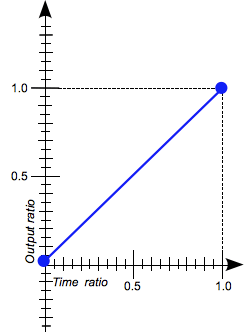
Linear
linear
The interpolation is done at a constant rate from beginning to end.
Equivalent to cubic-bezier(0.0, 0.0, 1.0, 1.0).
Cubic Bézier Curves
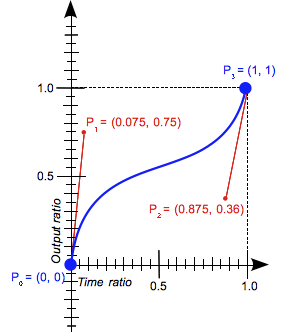
cubic-bezier(x1, y1, x2, y2)
Defines a cubic Bézier curve defined by:
- — the starting position
- — the final position
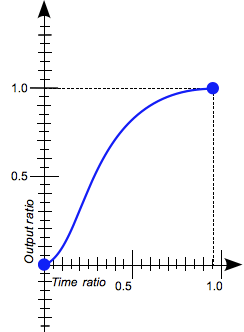
ease
Starts slowly, accelerates sharply, and then slows down towards the end.
(Equivalent to cubic-bezier(0.25, 0.1, 0.25, 1.0).)
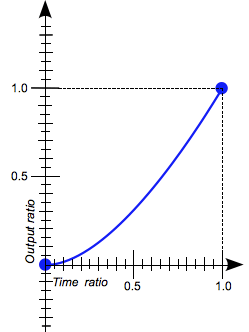
ease-in
Starts slowly, and accelerates towards the end.
(Equivalent to cubic-bezier(0.42, 0.0, 1.0, 1.0).)
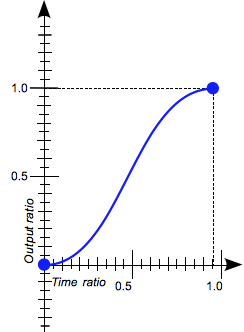
ease-in-out
Starts slowly, speeds up, and then slows down towards the end
(Equivalent to cubic-bezier(0.42, 0.0, 0.58, 1.0).)
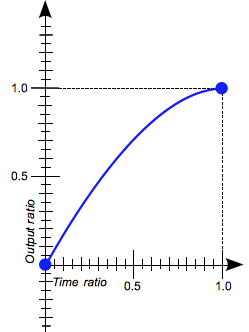
ease-out
Starts abruptly, and then slows down towards the end.
(Equivalent to cubic-bezier(0.0, 0.0, 0.58, 1.0).)
Step Functions
steps(n, jump)
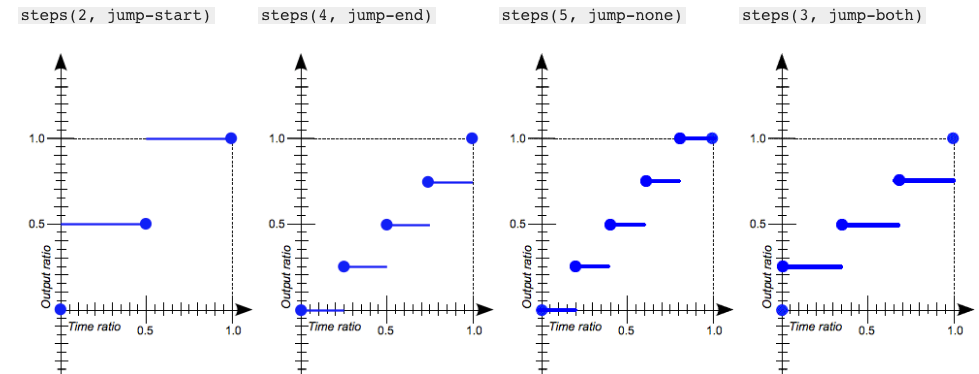
Defines a step function with n step(s) and which segment to jump:
jump-startorstart— skip the start segmentjump-endorend— skip the final segmentjump-none— include the start and final segmentsjump-both— skip both the start and final segments
jump values (Source: MDN)step-start
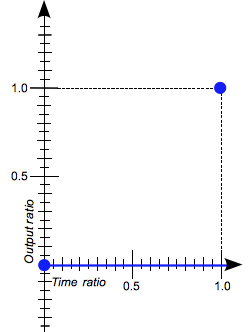
Skip the start segment (jumps directly to its final position).
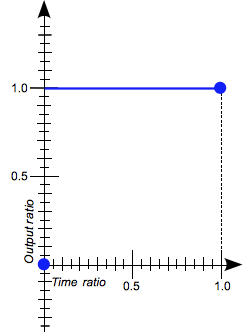
step-end
Skip the final segment (stays at its initial position).
Assets
- linear (MDN) — Appeared in https://developer.mozilla.org/en-US/docs/Web/CSS/easing-function — https://developer.mozilla.org/en-US/docs/Web/CSS/easing-function/cubic-bezier-linear.png
- Cubic Bézier (MDN) — Appeared in https://developer.mozilla.org/en-US/docs/Web/CSS/easing-function — https://developer.mozilla.org/en-US/docs/Web/CSS/easing-function/cubic-bezier-example.png
- ease (MDN) — Appeared in https://developer.mozilla.org/en-US/docs/Web/CSS/easing-function — https://developer.mozilla.org/en-US/docs/Web/CSS/easing-function/cubic-bezier-ease.png
- ease-in (MDN) — Appeared in https://developer.mozilla.org/en-US/docs/Web/CSS/easing-function — https://developer.mozilla.org/en-US/docs/Web/CSS/easing-function/cubic-bezier-ease-in.png
- ease-in-out (MDN) — Appeared in https://developer.mozilla.org/en-US/docs/Web/CSS/easing-function — https://developer.mozilla.org/en-US/docs/Web/CSS/easing-function/cubic-bezier-ease-in-out.png
- ease-out (MDN) — Appeared in https://developer.mozilla.org/en-US/docs/Web/CSS/easing-function — https://developer.mozilla.org/en-US/docs/Web/CSS/easing-function/cubic-bezier-ease-out.png
- step-start (MDN) — Appeared in https://developer.mozilla.org/en-US/docs/Web/CSS/easing-function — https://developer.mozilla.org/en-US/docs/Web/CSS/easing-function/steps-1-start.png
- step-end (MDN) — Appeared in https://developer.mozilla.org/en-US/docs/Web/CSS/easing-function — https://developer.mozilla.org/en-US/docs/Web/CSS/easing-function/steps-1-end.png


References
- <easing-function> (MDN) — https://developer.mozilla.org/en-US/docs/Web/CSS/easing-function