Event Loop
JavaScript codes run on a single thread (only one thing can happen at a time).
How it manages to handle concurrent tasks is through its event loop, which is responsible to collect and process queued tasks.
JavaScript runtime concepts
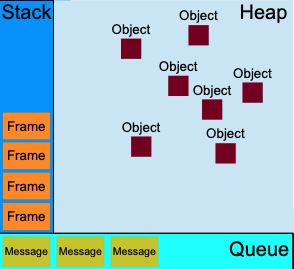
The theoretical representation of the JavaScript runtime memory is as follows. (Modern JavaScript engines may optimize what is described here.)
Note that it consists of the following elements:
- Call stack — Keeps track of function call order ("what calls what"). When a function is called, it gets added to the top of the Stack; when it returns, it gets popped from the stack.
- Heap — A large (mostly unstructured) region of the memory. Objects are placed here.
- Message queue — Messages (e.g.
setTimeouthandlers, events with event listeners) are placed here. Each message has a function reference that gets called when the message is handled. At some point during the event loop, JavaScript will start handling messages from the queue. - ES6 job queue — Promises are placed here. This works like the message queue, but processed with a higher priority.
How the event loop works
Waits synchronously for a message to arrive (if the queue is empty)
Process the next message in the queue
- Pop the message
- Call the associated handler function
- The handler function gets added to the call stack
Process the call stack
- If a function calls another function, add it to the call stack, and process the newly called function
- If a function does something that needs to be added to the queue (creating a promise), add it to the queue, and continue the rest of the current function
- When a function returns, pop it from the stack
- If a Promise resolves before the current function ends, it will be executed right after the current function
Loop
Example
Check your understanding by guessing in what order 1, 2, and 3 gets logged:
async function func() {
  // Timeout with 0ms delay
  setTimeout(() => {
    console.log(1);
  }, 0);

  // Promise that fulfills instantly
  Promise.resolve().then(() => {
    console.log(2);
  });

  // A synchronous console.log
  console.log(3);
}

func();
References
- Concurrency model and the event loop — https://developer.mozilla.org/en-US/docs/Web/JavaScript/EventLoop
- The Node.js Event Loop — https://nodejs.dev/learn/the-nodejs-event-loop
- Understanding the Event Loop, Callbacks, Promises, and Async/Await in JavaScript — https://www.digitalocean.com/community/tutorials/understanding-the-event-loop-callbacks-promises-and-async-await-in-javascript